



"Photography is one of the most polarized fields, where people use it for both beneficial and destructive purposes. Effective photographs can inspire greed or promote charity. Look at John Wesley Powell. He successfully used photography to promote himself into his historic role to survey and preserve the great open West and with the mysterious images, he inadvertently brought about its demise," Lacy reported.
Lacy developed the ability to design, control and manipulate the image to create a concise meaning, or a handle on the way the viewer reads the photograph. When he entered the arena of university promotional publications, Lacy philosophized, "The image I produce literally is the image of the university. The outside public's impression is based on how well I can show them the status and activities of the university."
"I don't think I could have worked to promote something I don't believe in." When Lacy originally studied Ansel Adams and Edward Curtis in art history he wasn't impressed, because he noted, "Students are usually interested in the latest cutting edge iconography and newest technologies to be utilized for shock value." But when he recognized the life-long dedication and commitment of these artists, and saw that they created substantial bodies of work suited to their beliefs, he discovered that that was his main requirement, as well, to do what he believed in.
"As a student, I dismissed the pretty pictures of clearing winter storms because they weren't gritty enough, or more because they didn't address what was wrong. They seemed to be made by people who were too easily satisfied with the things that were right on the surface. Corporate photography was the enemy of all fine arts students. It was designed to make you believe everything is alright and (it was) so shiny and clean that it couldn't possibly have required talent or dedication to make. I assumed that everything looked as pristine as it looked in the magazine and television ads. Little did I know, this superior image quality was extremely difficult to achieve."
"Promotion of education was acceptable to me. When I started working for the university, it had no way to compete in the emerging world of communications where the image governs all. I found the university severely disadvantaged, as all universities were suddenly competing in the corporate world. No one understood the requirements to move into modern times and everything was still done as it had been in the '70s and '80s. I had the ability and expertise to do things as they were going to be done in the next century," Lacy said.
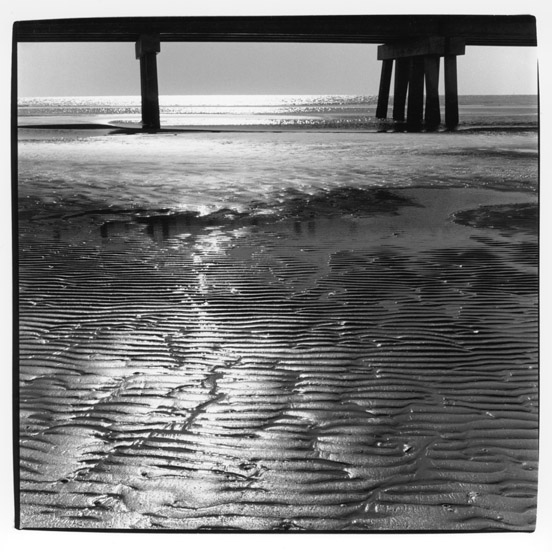
IN THE PHOTO ABOVE Lacy found one of his own commitments in the journal of Spanish explorer Cabeza de Vaca. Combining his experience as a surveyor and researcher to study the historic events of Cabeza de Vaca's journey, Lacy made photographs of places on the explorer's probable route along the Texas Gulf Coast and into Mexico.
As a photography student, Lacy produced the first digital negative at the university in late 1980s, and as a Student Program Board chairperson, he produced the first computer-formatted brochure for university promotion.
He stated in the University of Houston 75th Anniversary commemorative book, "Images in the book bring to mind the technological transformation the world and the university has witnessed. In these revolutions, laser imaging, digital processing, and the Internet, we are always at the forefront. We have seen the results (presented) in the Kennedy Center, scientific journals, network broadcasts and popular publications around the world. Living in a time of such monumental changes in visual communications has been invaluable, however, the increasingly diverse student population and multicultural learning opportunities at UH have provided even greater life experiences."
| SECTION |
|
CONTRASTING VIEWS LIFE DURING WARTIME PROPENSITY FOR VIOLENCE RIOTERS AND THRILL-SEEKERS THE VAPOR JETS RETHINKING ADAMS TRAVELS WITH SHIVAS AND ANGELS SEEING THE LIGHT A 9-1-1 WAKE-UP CALL |
if images appear dark.
