



"Following college, the most idealistic of fine artists become waiters and bank tellers," Lacy said, half joking. After his graduation in 1989, Lacy entered the world his civil engineer father first introduced him to as a surveyor working long days through the hot Oklahoma summers. His new job with the UH Cullen College of Engineering would present more mental than physical challenges. Despite years of study in journalism and fine arts, he lacked technical training. "Fine arts prepared me for critical analysis, conceptual thinking, issues, aesthetics, connotation, and so on, but didn't prepare me with the technical ability necessary to elevate my standards."
"Photography is a product of light and time, with almost infinite variables, and it requires extensive technical knowledge that photography professors usually cannot teach," Lacy explained. For the engineering faculty, he was required to record data from experimental processes invisible to the human eye. He calculated that a mechanical engineering experiment being conducted under Dr. John Lienhard's supervision would require scientific lighting equipment to make a capture exposure with a duration less than 1/200,000th of a second. The resulting still images of vapor jets, containing information necessary to effectively cool dangerous energy sources, had not previously been documented with photography or video.
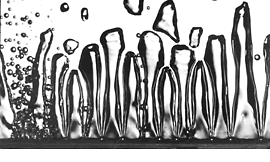
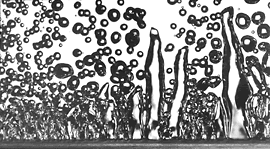
IN THE PHOTOS ABOVE Images that reveal technical and scientific information can have artistic qualities, but more importantly Lacy said, it is important for artists and journalists to have the ability to resolve technical problems so they can improve their own personal or professional work.
| SECTION |
|
CONTRASTING VIEWS LIFE DURING WARTIME PROPENSITY FOR VIOLENCE RIOTERS AND THRILL-SEEKERS THE VAPOR JETS RETHINKING ADAMS TRAVELS WITH SHIVAS AND ANGELS SEEING THE LIGHT A 9-1-1 WAKE-UP CALL |
