



Lacy was first introduced to Houston through the music of the Talking Heads, as well as other idealistic bands that turned their lyrical attention to serious matters of poverty, violence and racism in big cities. It was the mid1980s, long after the Ku Klux Klan bombings of KPFT and the drowning of Joe Campos Torres at the hands of Houston Police, when Lacy moved to Houston from a small Oklahoma town. The Klan was marching in Texas cities and many young radicals fostered bitter resentment of those involved in the terror of the 1970s. Though he was a newcomer to the city, Lacy shared their resentment. A Black friend had been murdered in Oklahoma, reportedly by the Klan. Lacy chanced upon a flier pinned to a bulletin board in the University of Houston Roy Cullen Building seeking volunteers to help "Fight the Klan" by joining the John Brown Anti-Klan Committee.
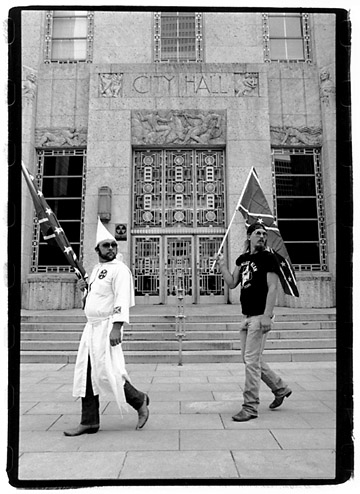
IN THE PHOTO ABOVE The Klan marches in downtown Houston. Read Lacy's comments in the on-line interview (to be posted May 20).
Eager to follow in the footsteps of great journalists, like Susan Meiselas and Mary Ellen Mark, who were producing socially-relevant material, Lacy took a position with the John Brown Anti-Klan Committee as a volunteer photographer and began to document the activities of racist organizations and Texas militia groups, as well as the counter activities of opposition groups. Lacy realized the serious implications of making photographs of controversial subjects when he and other John Brown members were forced out of a Pasadena KKK bookstore by a woman with a shotgun.
| SECTION |
|
CONTRASTING VIEWS LIFE DURING WARTIME PROPENSITY FOR VIOLENCE RIOTERS AND THRILL-SEEKERS THE VAPOR JETS RETHINKING ADAMS TRAVELS WITH SHIVAS AND ANGELS SEEING THE LIGHT A 9-1-1 WAKE-UP CALL |
Lacy learned that photography is more than the snapshots made by partygoers and family members; it is used to influence opinion and record history. According to Lacy, "Authorities and radical organizations with dire objectives use surveillance and espionage as they face each other in public demonstrations or in their subversive activities... Whether on Bourbon Street, spring break or robbing a bank, photography is the ultimate evidence of people and their activities."
