



In the digital world, Lacy developed a reputation as an effective advisor on the logistics of visual communications for institutions and businesses. He advocated for the highest quality standards and developed plans to help organizations with the implementation of new technology. He combined his extensive knowledge of diverse culture and media to offer service he considered appropriate and timely.
As an expert in a new field with his choice of clients, mostly educational organizations and adventure travel companies, and with his strong ambition to develop a non-profit organization and write about and photograph regional culture, Lacy couldn't see a clear direction. Each new possibility seemed to impair the other and he described feeling overwhelmed with frustration. His non-profit activities were fueled by his lucrative contracts, but progress establishing programs for the Houston Institute for Culture was slow.
Following September 11, many companies Lacy had consulted for found themselves financially unable to pursue new projects. Rather than seek new clients, Lacy chose to return to the projects that are important to his beliefs and promote the high quality of life people can experience with cultural education.
Several years ago, Lacy originated a provocative series of historical-fiction stories, The Adolf Trojan Chronicles, which explored issues of integration and assimilation of cultures in SE Texas through the experience of Eastern European immigrants and Native Americans. Unusual real-life characters came in and out of the short stories, like: New Orleans' voodoo priest 'The Chicken Man'; the wanderer Alex Supertramp; singer/social agitator Jello Biafra; the romanticized wild Indian Monk Boudreaux; and the Tewa-Navajo storyteller Ed Defender. The series combined research, anecdotes and family histories to explore issues of culture, politics and economics in the southeast Texas region.
Lacy said, "(There is) a terrible misconception in the 'New World Order' or 'Global Economy' that economic issues are universal. In fact the economy is not the same thing to all people. It is different in Third Ward and Austin and Tamaulipas and Afghanistan. There are prevailing cultural issues. The more one group has the opportunity to get ahead, the more likely another group is to fall behind. One group gains more or profits from the other. That's 'Intro to Business 101'. Not everyone will prosper and not everyone will want to consider the standards the same way."
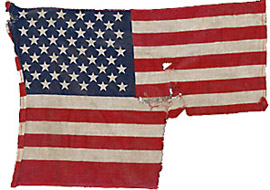
IN THE PHOTO ABOVE A small American flag, torn with pieces missing, found on the ground near Bob Wills' grave in Tulsa, Oklahoma symbolizes many things about America. Because the flag was discovered by Lacy just as he learned of the historic "Black Wall Street" massacre in Tulsa, he photographed this powerful image as potential art for a book he is writing about regional culture.
| SECTION |
|
CONTRASTING VIEWS LIFE DURING WARTIME PROPENSITY FOR VIOLENCE RIOTERS AND THRILL-SEEKERS THE VAPOR JETS RETHINKING ADAMS TRAVELS WITH SHIVAS AND ANGELS SEEING THE LIGHT A 9-1-1 WAKE-UP CALL |
Lacy is working with a grant to produce the research project as a multimedia book. He is concurrently working toward improved cultural literacy and preservation by developing and promoting increased support for the Houston Institute for Culture. He is planning a cultural education camp for kids called Camp Dos Cabezas. Information can be found on line at www.houstonculture.org/camp. He believes with the events of September 11, that exploring these issues has been elevated to a new level of necessity in our society.
"As I learned volunteering for the John Brown (Anti-Klan) Committee, even on the side of right there are issues of right and wrong. It's extremely relevant today. People are often so involved in thinking that they are right, that they cannot face real issues from another perspective. Somewhere along the way they have not been taught to think independently or to explore the issues. Photography forced me to think independently in every situation."
ADDITIONAL CONTENTS At the conclusion of the article is an interview with Mark Lacy on photography and culture.
