
APERTURE AND SHUTTER ADJUSTMENTS
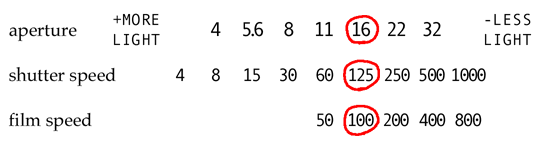
In the above chart, the Aperture and Shutter Speed Settings indicate a range that will allow More or Less Light to reach the Film through the Lens and Shutter. The Film Speed is arranged to show its direct correlation with the Aperture and Shutter. Starting from the Basic Daylight Exposure with 100 Speed Film, shown in the above chart, if you increase the Aperture (+) One Stop, you must decrease the Shutter (-) One Stop to produce an equal Exposure. Practice choosing a faster Shutter Speed (A faster Shutter Speed is shorter duration of time, allowing less light to reach the film) and the necessary Aperture needed to maintain a consistent Exposure.
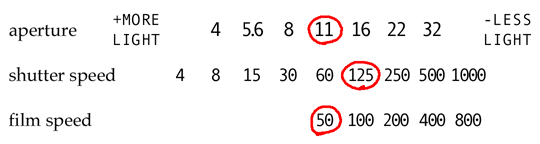
In the above chart, the selected Film Speed is One Stop slower than the Film Speed represented above. To make an Exposure comparable with the Basic Daylight Exposure for 100 Speed Film, you must open the Aperture (+) One Stop (shown) or slow the Shutter Speed (+) One Stop. Where would you start to make a Basic Daylight Exposure if you wanted to use a faster Film Speed, such as 400?
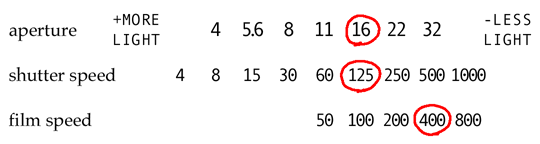
The above hypothetical Exposure is not the Basic Daylight Exposure. Being (+) Two Stops over (as we are now using 400 Speed Film), it is more likely to be a typical exposure on an mildly overcast day. If you shorten the Shutter Speed to 1/1,000th of a second, to make it possible to "freeze" fast motion or hand hold a Long Lens, what Aperture Setting would you use?
Practice making adjustments to the Aperture and Shutter with this printer-friendly page of
HIFC FIELD GUIDE | Return to Exposure | Return to Exercises | info@houstonculture.org
Updated Oct. 2001